






In todays business environment, success is no longer measured only by revenue and profitability. Customers, investors, financial institutions, regulators, and global buyers increasingly expect businesses to operate responsibly, sustainably, and transparently.

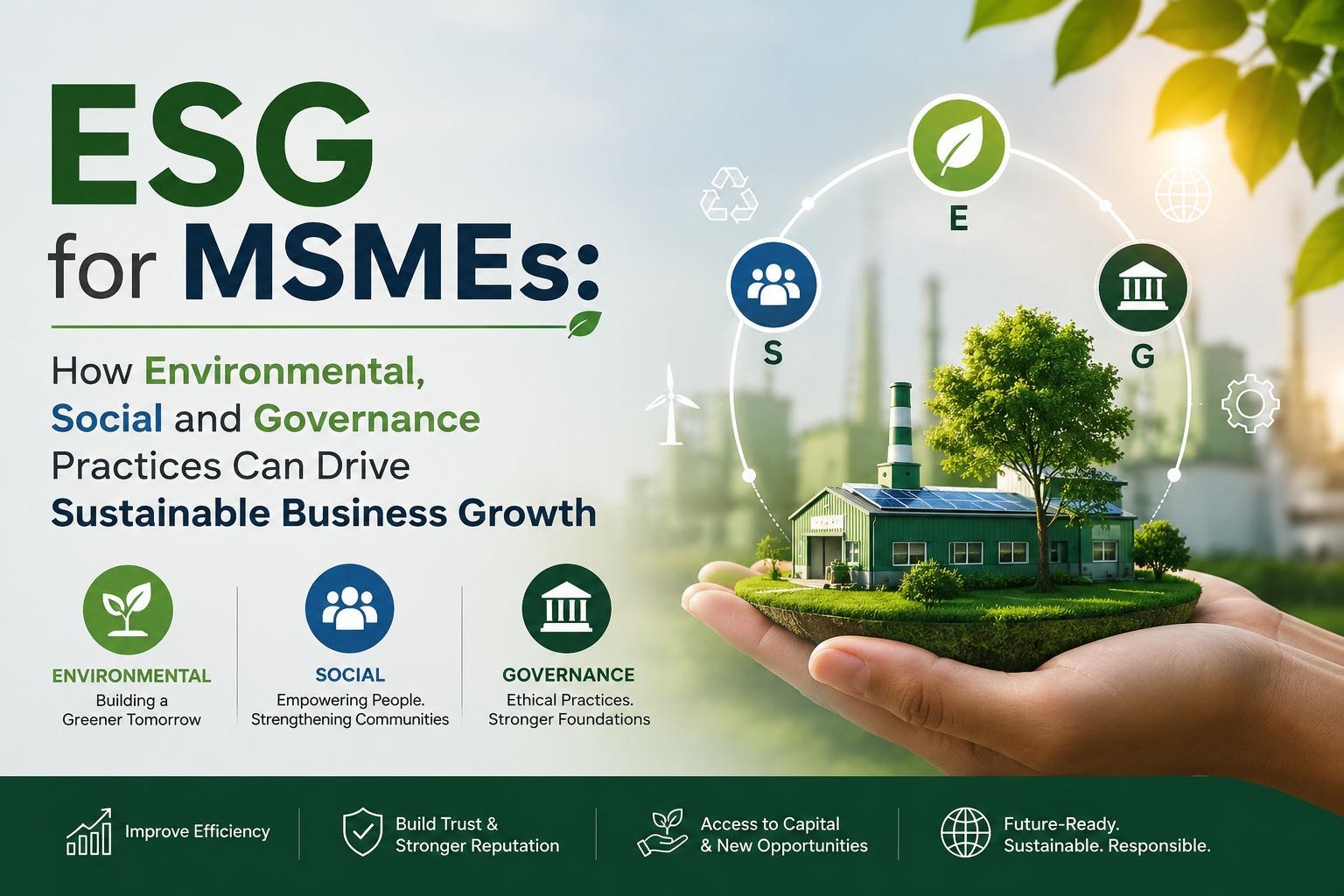
ESG for MSMEs: How Environmental, Social and Governance Practices Can Drive Sustainable Business Growth
In todays business environment, success is no longer measured only by revenue and profitability. Customers, investors, financial institutions, regulators, and global buyers increasingly expect businesses to operate responsibly, sustainably, and transparently.
For Micro, Small, and Medium Enterprises (MSMEs), this shift presents both a challenge and an opportunity. Businesses that embrace Environmental, Social, and Governance (ESG) practices are finding new ways to improve efficiency, reduce risks, attract customers, access funding, and strengthen their market position.
Recognising the growing importance of sustainability, the RAMP (Raising and Accelerating MSME Performance) Programme is promoting ESG awareness among MSMEs through dedicated capacity-building initiatives and workshops across India.
What is ESG?
ESG stands for three key pillars that help organisations build sustainable and resilient business models capable of adapting to changing market expectations.
Environmental
Environmental refers to how a business manages its impact on the environment. It focuses on responsible use of natural resources, reducing pollution, improving energy efficiency, and minimising environmental impact through sustainable business practices.
Social
The Social pillar focuses on how a business interacts with its employees, customers, suppliers, and local communities. It includes employee welfare, workplace safety, diversity and inclusion, customer satisfaction, and community engagement.
Governance
Governance refers to how a business is managed through transparency, accountability, ethical leadership, regulatory compliance, and responsible decision-making. Strong governance helps organisations build trust with investors, customers, lenders, and other stakeholders.
Together, these three pillars help organisations build sustainable and resilient business models capable of adapting to changing market expectations.
Why ESG Matters for MSMEs
For many business owners, ESG may seem like a concept designed primarily for large corporations. However, sustainability is becoming increasingly important for enterprises of all sizes.
Today, buyers and supply chains are paying closer attention to environmental and social practices. Financial institutions are beginning to evaluate sustainability-related risks, while customers increasingly prefer businesses that demonstrate responsibility and ethical conduct.
For MSMEs, ESG is no longer just about compliance—it is becoming a competitive advantage. Businesses that adopt ESG practices early are better positioned to access new opportunities, strengthen stakeholder trust, and prepare for future market requirements.
The Business Benefits of ESG for MSMEs
Adopting Environmental, Social, and Governance (ESG) practices offers far more than regulatory compliance. For MSMEs, ESG provides practical business advantages that improve operational performance, strengthen market credibility, and create long-term growth opportunities.
As customers, investors, financial institutions, and supply chains increasingly prioritise responsible business practices, MSMEs that embrace ESG are better positioned to compete in both domestic and international markets.
Improved Operational Efficiency
Many ESG initiatives focus on reducing waste, improving resource utilisation, and increasing energy efficiency.
Simple actions such as optimising energy consumption, reducing material wastage, or adopting environmentally friendly production methods can significantly lower operating costs.
Improved efficiency often leads to better profitability and stronger business performance.
Stronger Market Competitiveness
Customers and buyers increasingly prefer businesses that demonstrate responsible practices.
MSMEs that adopt ESG principles often gain a stronger reputation and improve their ability to compete in domestic and international markets.
For export-orientated businesses, ESG practices are becoming particularly important as global buyers place greater emphasis on sustainability standards.
Better Access to Finance
Banks, financial institutions, and investors are increasingly incorporating sustainability considerations into their decision-making processes.
Businesses with clear ESG practices may find it easier to access financing opportunities and participate in sustainability-linked programmes and initiatives.
Enhanced Brand Reputation
Trust is one of the most valuable assets for any business.
Organisations that prioritise employee welfare, customer satisfaction, environmental responsibility, and ethical governance often build stronger relationships with stakeholders and enhance their brand image.
Reduced Business Risks
Strong governance systems, environmental compliance, and responsible labour practices help businesses reduce operational, legal, and reputational risks.
ESG provides a framework for identifying potential challenges before they become costly problems.
Understanding the Three Pillars of ESG
Environmental: Building Sustainable Operations
The environmental component focuses on minimising the impact of business activities on natural resources and ecosystems.
For MSMEs, practical environmental initiatives may include:
- Improving energy efficiency
- Reducing waste generation
- Conserving water resources
- Adopting cleaner production methods
- Using eco-friendly packaging
- Implementing responsible sourcing practices
Even small improvements can generate long-term cost savings while supporting environmental sustainability.
Social: Strengthening People and Communities
The social dimension focuses on creating positive relationships with employees, customers, suppliers, and local communities.
Key social practices include:
- Ensuring workplace safety
- Providing fair wages and benefits
- Promoting diversity and inclusion
- Maintaining product quality and customer satisfaction
- Supporting community development initiatives
- Encouraging employee well-being
Strong social practices contribute to employee retention, customer loyalty, and business credibility.
Governance: Creating Transparency and Accountability
Governance refers to the systems and processes that guide business decision-making.
For MSMEs, effective governance may include:
- Transparent business practices
- Ethical leadership
- Strong internal controls
- Financial accountability
- Regulatory compliance
- Anti-corruption measures
Good governance builds trust among investors, lenders, customers, and business partners.
ESG and the Future of Global Supply Chains
Sustainability is becoming a key requirement across global value chains.
Large corporations increasingly prefer suppliers that can demonstrate responsible environmental and social practices.
As a result, MSMEs that adopt ESG principles today may gain a significant advantage in becoming part of domestic and international supply networks tomorrow.
ESG is gradually shifting from being a voluntary initiative to becoming a business expectation.
ESG Awareness Under the RAMP Programme
To help MSMEs understand and implement sustainability practices, the RAMP Programme is supporting ESG awareness initiatives and workshops across the country.
Objectives of ESG Awareness Under the RAMP Programme
The RAMP (Raising and Accelerating MSME Performance) Programme is actively promoting ESG awareness among MSMEs through dedicated workshops and capacity-building initiatives across the country.
These programmes are designed to help enterprises understand sustainability concepts and integrate responsible business practices into their day-to-day operations.
The workshops aim to help MSMEs:
- Understand ESG concepts and their relevance to business growth.
- Identify sustainability-related risks and business opportunities.
- Develop practical ESG implementation strategies.
- Improve regulatory and compliance readiness.
- Access ESG-linked opportunities and support systems.
- Build future-ready and sustainable business models.
The awareness programmes focus on practical, affordable, and easy-to-implement approaches that can be adopted by MSMEs irrespective of their size, location, or sector.
Why Early Adoption Matters
Businesses that begin their ESG journey today are likely to be better prepared for future regulations, changing customer expectations, and evolving market requirements.
Early adoption allows enterprises to build stronger operational systems, improve stakeholder confidence, and create a competitive advantage before ESG becomes a mandatory business requirement.
More importantly, ESG helps create enterprises that are:
- Efficient
- Competitive
- Responsible
- Resilient
- Sustainable
These qualities are becoming increasingly important in todays rapidly changing business environment, where sustainability and responsible business practices are key drivers of long-term success.
Conclusion
Environmental, Social, and Governance (ESG) practices are no longer limited to large corporations. They are becoming an essential part of building successful and sustainable businesses across every sector.
For MSMEs, ESG offers an opportunity to improve operational performance, strengthen market credibility, attract new business opportunities, reduce long-term risks, and create lasting value for customers, employees, investors, and society.
By integrating sustainability into business strategy today, enterprises can position themselves for stronger growth, greater resilience, and long-term success.
In a world where responsible business is increasingly becoming smart business, ESG is not just a framework—it is a pathway to sustainable growth, enhanced competitiveness, and a resilient future for MSMEs.